A travel piece with Patagonia to stop Salmon farming in Iceland. Published in Wavelength Surf Magazine 2026
As I looked up from reading The New Fish: ‘The Truth about Farmed Salmon and the Consequences We Can No Longer Ignore’, deeply engrossed in the unfortunate fate of farmed salmon, I pressed my face against the cold, plastic window and peered down into another world. Thick white clouds cleared and we flew low over barren landscapes painted in grey and dark moss green. With empty, lonely roads for miles, only interrupted by clusters of power stations and factories, I instantly felt that this place was alien and different, like a place long forgotten by most.
There was melancholy as we drove through the Nordic scenery, one that felt both off putting and alluring, yet the vast empty spaces of nature rolled on endlessly, inviting us into their mysterious, eerie arms. We were there on a mission. First impressions were an insight into how this was not to be like any usual surf trip – something was amiss and we were there to learn about it.
As surfers, we are so immensely connected to a living entity that is outside our own mind and body. Waves move us. So when we hear about industries wantonly putting the thing we love most at risk, it can awaken a drive in us that cannot be stopped. I used to be an ocean-goer who gave so much more back to the very thing that breathed life into my existence. Yet, when the repetitive nay-sayers, enforcing their messages of hopelessness that we do not possess the power to change the hand that feeds us, I gave up. So when I got the call that I was going to Iceland, with some of the most influential names in the surf space – to help fight back against a destructive fishing industry – I was admittedly sceptical, ‘Could us surfers truly positively enforce any real change?’ But of course, doubt aside, I packed my bag, cramming camera and 6mm suit inside, and there I was, amongst the moon-like mountainscapes.
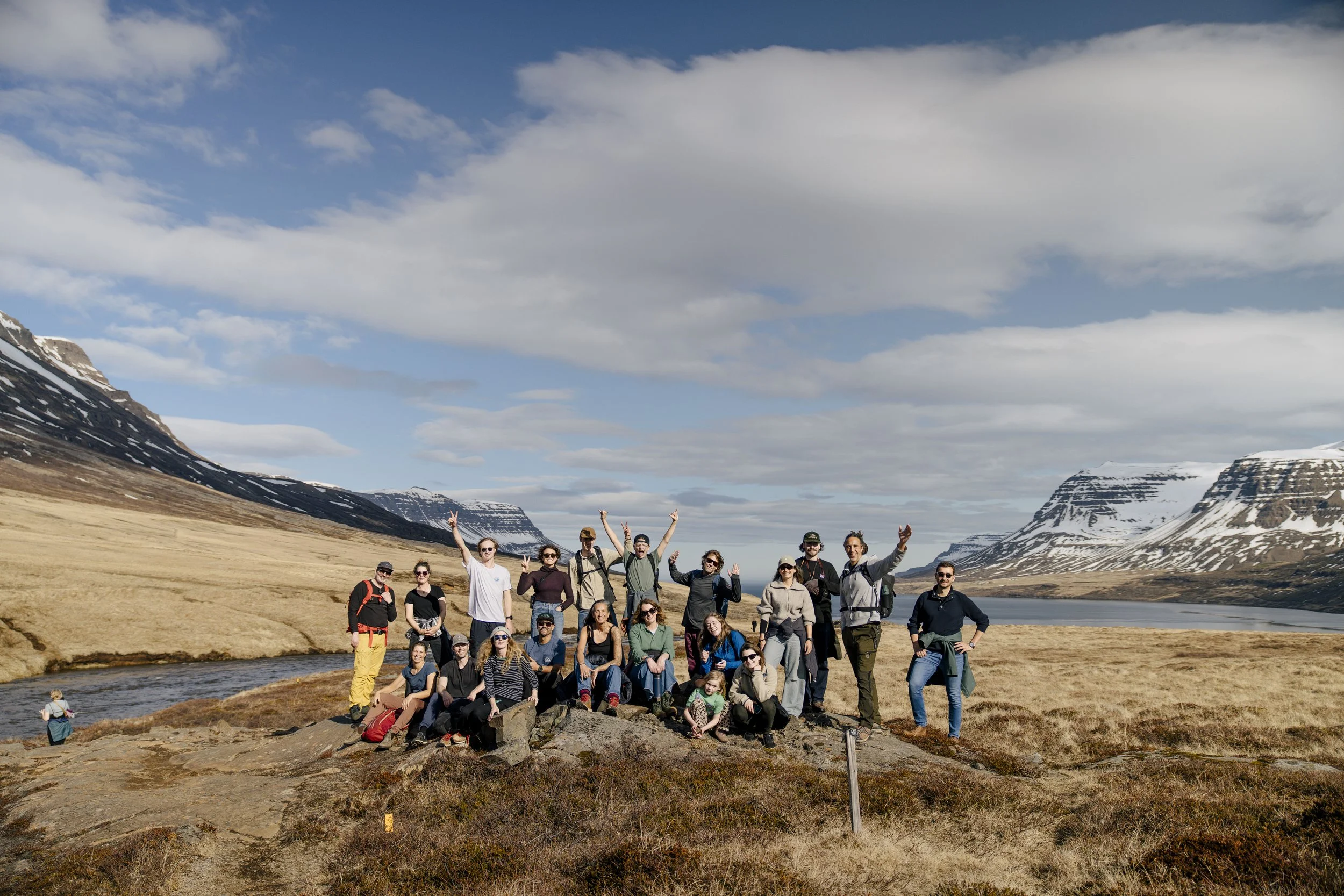
We had been invited by locals in Iceland, who are working with the team at Patagonia, to kick the salmon farming industry out of their fjords. It was an impact camp, a place to listen and learn, about not only the industry, but our own guilty parts to play in human greed culture. Our crew was made up of talented journalists, activists, surf shakers and movers from all over the globe. People such as Ramon Navarro, Jamie Brisick, Sam Haddad, Elli Thor and many more who left me feeling starstruck. I was amongst surf rockstars. Not just because they slide on water well, but are all people putting their energy into altruistic actions, working towards the common good and yes, surfing along the way.
For many of us, myself included, the truth about open-net salmon farming has not been at the forefront of our minds. And sadly it’s not good news. For too long we have been fed a false narrative. That the beautiful, wild and colourful salmon that swim in our planet's fjords are the ones that end up on our plates. The labels on our supermarket-packaged pink fish say, ‘sustainably caught in fresh water’ however, when you truly think about it, how can it be that every shop, on every corner, on every street, has fresh, line-caught fish – neatly wrapped in plastic and easily ready for your dinner?
Since the 1970s, this problem has risen from murky waters. Scientists and leaders were desperate in their search for quick, healthy solutions to feed our never-ending, ever-expanding, human race. They gazed upon the previously assumed endless resources of the vast ocean. The unlucky wild Atlantic salmon became the new pillar of health and hope, an exemplary fish, nutritious, good-looking, and hardy enough to withstand intense reproduction. So began the prodding and testing to perfect the mass production of this vibrant sea creature.
One of our inspiring hosts, Jón Kaldal [Icelandic Wildlife Fund’s (IWF) strategist and spokesperson] who is at the forefront of this fight, told us: “Salmon farming is not a food production system, it’s a food reduction system”, and that in Norway, native wild salmon is now down to less than 50% of its population due to this industry. As we all attentively sat in our makeshift classroom for the week, with the gorgeous, majestic mountains at Jón’s back, reminding us what was at stake.
“The industry has a 40-year history in Iceland, collapsing around 1990 before restarting early this century. Growth accelerated rapidly over the last decade following the entry of major Norwegian industrial open-net pen farming companies. Open-net pens are the source of a continuous torrent of parasites, pollution, disease, and escaped salmon, leading to genetic contamination. This genetic mixing obliterates 10,000 years of evolutionary adaptation, drastically reducing the wild population’s ability to survive.”
Open-net pens are placed in nature's Fjords and coastal inlets – the long, narrow arms of the sea that weave all living things together. Fjords breathe life, create safe havens for habitats to thrive, give humans joy, and allow us to voyage between countries. Unfortunately, with their rich, cold, clean, and still waters, they are also the ideal breeding ground for the toxic agricultural industries to invade and contaminate.
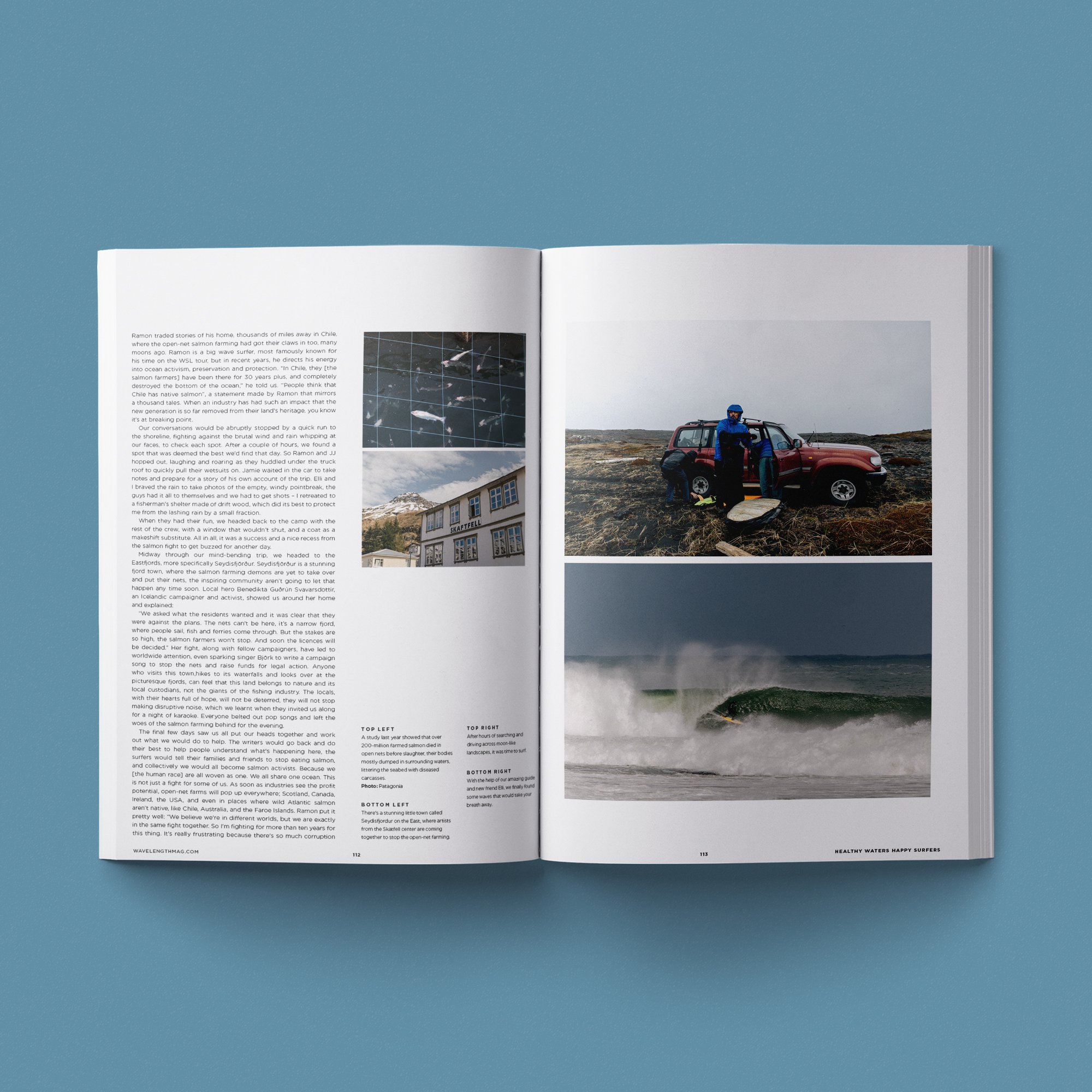
Society now knows the fate of an unlucky battery farm chicken, condemned to a life stripped of their basic animal rights. Well, the open-net salmon face a similar dark future – on average each deadly net usually has around 10,000 squeezed in. A study last year showed that over 200 million farmed salmon died in open nets before slaughter, their bodies mostly dumped in surrounding waters, littering the seabed with diseased carcasses. With that many living beings in one place, it’s a recipe for disease and disaster. One bad example among the many – they aren’t eating their natural diet. Instead, they are fed mass-produced small fish like anchovies, sardines, and mackerel, taken from the coasts of South America. Without their native diet, farmed salmon can turn grey. The industry's “solution” to this is adding a supplement called astaxanthin, a substance with inconclusive research on its effects during pregnancy, which colours the flesh pink. Crowded pens also breed parasites like sea lice, leaving fish riddled with sickness, with degraded skin and defects at birth.
Between days learning about the salmon, we hit the road in Elli Thor’s trusty rusty truck, in search of what waves Iceland had to offer. Many hours were spent in the car, driving through evacuated ghost towns and over black volcanic sand, where there was no way of knowing just how long it had been since tyres or footsteps had last been there. The truck was full with Ramon, Jamie, JJ [Higgins] and I, with only two subjects on our collective minds; salmon and surfing. Jamie was quietly observing and scribbling away, Ramon was preparing his yerba mate to fuel him, while Elli told us of his home country: “there is so much political power and pressure. They [the salmon farming industry] pay for the local school and soccer team, so people are scared to say anything, because fishing was our big thing, right? It was the biggest industry here before tourism.” Elli lives in a cabin by a fjord, where 12 pens are situated, meaning he and his family are exposed to the death of salmon daily.
We repeatedly stopped, looked at waves, got back in the car and carried on driving. Elli had spent many hours studying the coastline, he was truly tapped into where had potential, so we blindly and happily followed him to any spots.
Ramon traded stories of his home, thousands of miles away in Chile, where the open-net salmon farming had got their claws in too, many moons ago. Ramon is a big wave surfer, most famously known for his time on the WSL tour, but in recent years, he directs his energy into ocean activism, preservation and protection. “In Chile, they [the salmon farmers] have been there for 30 years plus, and completely destroyed the bottom of the ocean,” he told us. “People think that Chile has native salmon”, a statement made by Ramon that mirrors a thousand tales. When an industry has had such an impact that the new generation is so far removed from their land's heritage, you know it’s at breaking point.
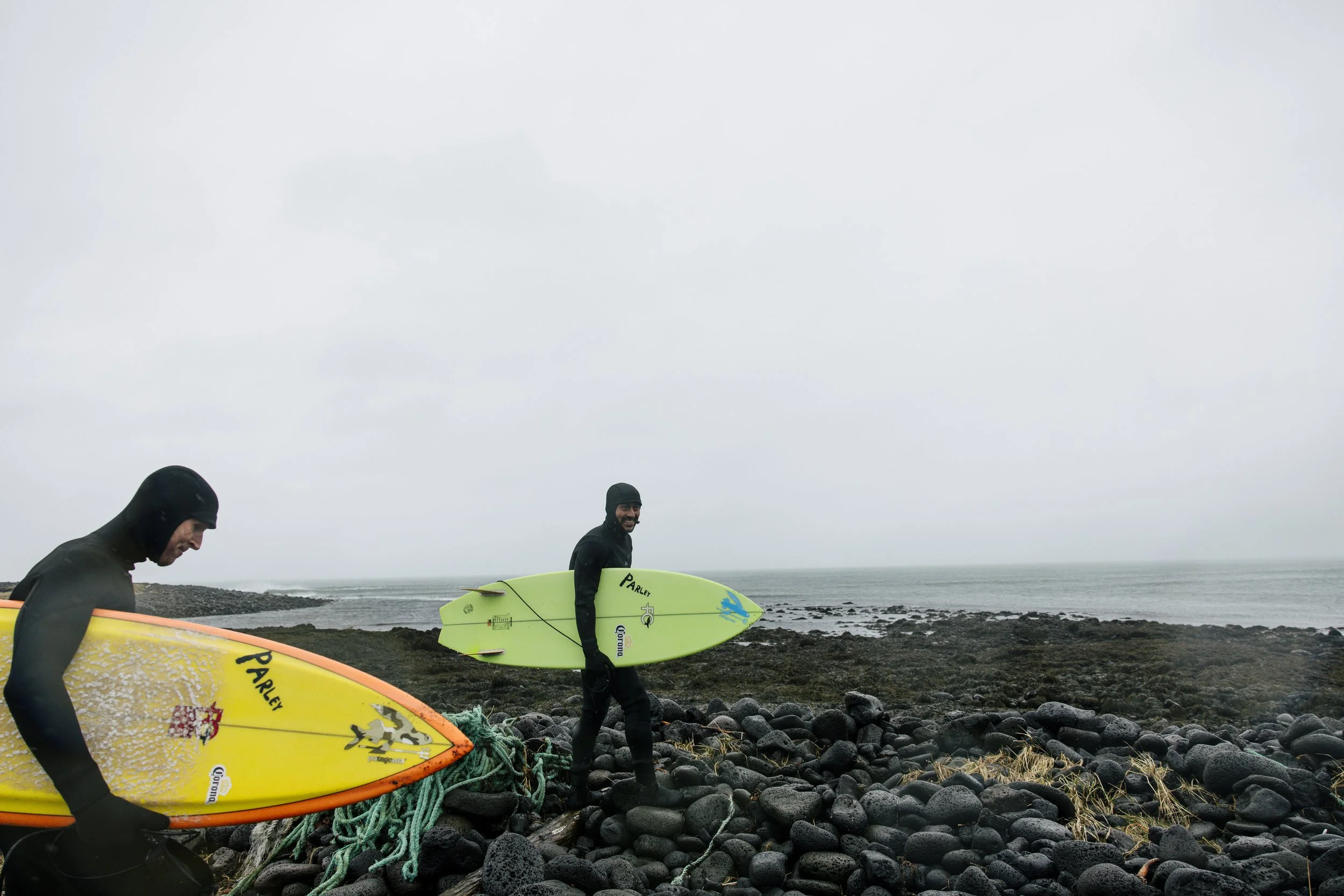
Our conversations would be abruptly stopped by a quick run to the shoreline, fighting against the brutal wind and rain whipping at our faces, to check each spot. After a couple of hours, we found a spot that was deemed the best we’d find that day. So Ramon and JJ hopped out, laughing and roaring as they huddled under the truck roof to quickly pull their wetsuits on. Jamie waited in the car to take notes and prepare for a story of his own account of the trip. Elli and I braved the rain to take photos of the empty, windy pointbreak, the guys had it all to themselves and we had to get shots – I retreated to a fisherman's shelter made of drift wood, which did its best to protect me from the lashing rain by a small fraction.
When they had their fun, we headed back to the camp with the rest of the crew, with a window that wouldn’t shut, and a coat as a makeshift substitute. All in all, it was a success and a nice recess from the salmon fight to get buzzed for another day.
Midway through our mind-bending trip, we headed to the Eastfjords, more specifically Seydisfjörður. Seydisfjörður is a stunning fjord town, where the salmon farming demons are yet to take over and put their nets, the inspiring community aren’t going to let that happen any time soon. Local hero Benedikta Guðrún Svavarsdottir, an Icelandic campaigner and activist, showed us around her home and explained:
“We asked what the residents wanted and it was clear that they were against the plans. The nets can't be here, it’s a narrow fjord, where people sail, fish and ferries come through. But the stakes are so high, the salmon farmers won't stop. And soon the licences will be decided.” Her fight, along with fellow campaigners, have led to worldwide attention, even sparking singer Björk to write a campaign song to stop the nets and raise funds for legal action. Anyone who visits this town,hikes to its waterfalls and looks over at the picturesque fjords, can feel that this land belongs to nature and its local custodians, not the giants of the fishing industry. The locals, with their hearts full of hope, will not be deterred, they will not stop making disruptive noise, which we learnt when they invited us along for a night of karaoke. Everyone belted out pop songs and left the woes of the salmon farming behind for the evening.
The final few days saw us all put our heads together and work out what we would do to help. The writers would go back and do their best to help people understand what's happening here, the surfers would tell their families and friends to stop eating salmon, and collectively we would all become salmon activists. Because we [the human race] are all woven as one. We all share one ocean. This is not just a fight for some of us. As soon as industries see the profit potential, open-net farms will pop up everywhere; Scotland, Canada, Ireland, the USA, and even in places where wild Atlantic salmon aren’t native, like Chile, Australia, and the Faroe Islands. Ramon put it pretty well: “We believe we're in different worlds, but we are exactly in the same fight together. So I'm fighting for more than ten years for this thing. It's really frustrating because there's so much corruption in these things. We need to be as a team and maybe one day we can have a hope to try to make these people understand and make politicians understand.”
As a thank you for all of Ramon’s ocean activism, the Icelandic sea gave him one last epic ride. It came after another day of trying to score and coming up short, until Elli’s surf senses finally tingled and he led us to a spot not for the faint-hearted. For a couple of glorious hours, we watched in awe as Ramon pulled into the deepest, coldest-looking barrels I’ve ever laid eyes on. These were waves locals had told us were only for the boogers, but perhaps no one had ever seen a big-wave pro like Ramon give them a proper crack.
It was wild. The beach air was filled with whooping and cheering even though I doubt Ramon could hear us through the walls of foam. It was a session to remember and by the next day, the wave was gone. I couldn’t help but think the sea had put that show on especially for us.
This trip and this story is not just about salmon. This is about the collective power we have as people, about the energy that burns inside us as those connected to the sea, energy that can be used for productive change, to stop the further demise of marine life. If you too want to do something about this issue you can, the time has passed for us to sit back as bystanders. Our societies are led to believe we must wait for others to make decisions, to let leaders be the guiding light who will bring us out of the dark times. This is a lore that has been passed through generations, leaving us feeling powerless to stand up against oppression. As Jon Alexander, writer of ‘Citizens’ explains, the consumer story narrative we have been trapped in is “limiting us, holding us back and telling us we’re not the ones to solve the problems of our world.” But if we flip this notion on its head, and take matters into our own hands, we become citizens once more: “humans who want to shape the world around us for the better, and who claim, and where necessary, demand the right and means to do so”, Alexander says in his book. And the simple way to start rebelling against the fishing oligarchs is to take a look at your shopping basket. Let the daily choices you make start to change everything.
To draw the trip to a close, our guide Halldór Hreinsson, surprised us with a rendition of Frank Sinatra on the bus to the airport. It had us all singing at the top of our lungs, close to tears and full of fire, as Ol’ Blue Eyes reiterated what we all needed to hear: “For what is a man, what has he got? If not himself, then he has naught. To say the things he truly feels and not the words of one who kneels. The record shows I took the blows and did it my way.”